

How to Discreetly Test Drinks for Substances at Parties
Table of Contents
- Why Testing Your Drink Discreetly Matters
- How Drink Testing Kits Work: The Science Made Simple
- Drink Spiking Test Strips in Australia: What to Look For
- Step-by-Step: How to Test Your Drink Discreetly at a Party
- How to Prevent Drink Spiking Before It Happens
- What to Do If You Suspect Your Drink Has Been Spiked
- Conclusion
Last Updated: August 21, 2026
Why Testing Your Drink Discreetly Matters
Drink spiking is a genuine public safety concern at parties, festivals, and nightlife venues. The substances most commonly used are colourless, odourless, and nearly impossible to detect by taste alone. At Safer Sips, we've worked with researchers and independent laboratories for over four years to develop science-backed solutions that let you test drinks discreetly, without drawing attention or disrupting your night.
The ability to test drinks for unknown substances at parties preserves your autonomy in social settings where you may not control who handles your drink or how crowded the room gets. Below, we'll walk through exactly how drink testing technology works, what to look for in a product, and how to use it naturally rather than conspicuously.
What Are Date Rape Drugs and Why Are They Hard to Detect?
Date rape drugs are substances used to incapacitate a person without their knowledge or consent, typically by adding them to a beverage. The most commonly reported substances include GHB (gamma-hydroxybutyrate), Ketamine, Rohypnol, and certain benzodiazepines. These are central nervous system depressants that act rapidly, impairing memory, coordination, and the ability to resist or recall events.
What makes them so dangerous is their physical profile. Many dissolve instantly and leave no visible residue, colour change, or detectable flavour. According to Australian Institute of Health and Welfare guidance on drug use, GHB in particular is difficult to identify because it occurs naturally in the body at low levels, meaning victims often don't realise something is wrong until symptoms are well advanced.
Signs Your Drink May Have Been Tampered With
Most people assume they'd notice if something was wrong with their drink. In practice, that's rarely the case. Watch for sudden, disproportionate dizziness or disorientation relative to consumption; an unusual taste (salty, soapy, or chemical); feeling significantly more intoxicated than your intake would explain; confusion, blurred vision, or muscle weakness that comes on rapidly; or a drink that appears cloudier than when you last saw it.
The problem is that by the time symptoms appear, the substance is already in your system. That's why preventative substance detection, testing before you drink, not after, is the only reliable approach to beverage safety.
How Drink Testing Kits Work: The Science Made Simple
Reagent-based testing is the core technology behind most drink spiking detection products available today. A small sample of your beverage is exposed to a chemical reagent, and if a target substance is present, a chemical reaction produces a visible colour change. The process is fast, requires no laboratory equipment, and can be completed in seconds.
Test Strips and Reagent Testing
Test strips work by impregnating a paper or polymer substrate with one or more reagents that react selectively to specific compound classes. When you dip the strip into your drink or apply a drop of liquid to the test zone, the reagent interacts with any matching substances in the sample. A colour change, typically from one defined colour to another, indicates a positive result.
Reagent testing has been a cornerstone of harm reduction and drug checking services for decades. Safer Sips test strips detect GHB, Ketamine, and more than 650 amine-based compounds, developed over four years with leading researchers and independently tested by accredited laboratories and universities.
Wristband Testing and Other Formats
The format of a testing product matters significantly when you're trying to test drinks discreetly in a crowded venue. Wristband-style testers are worn on your wrist and carry two test strips per band, keeping them immediately accessible. Card-style test strips fold into a wallet or slip into a phone case. Matchbook formats fit in a jacket pocket.

| Format | Best For | Tests per Unit | Discreet? |
|---|---|---|---|
| Single Strip Card | Casual nights out | 1 test | Yes |
| Double Strip Card | Nights with multiple drinks | 2 tests | Yes |
| Matchbook Pack (8 strips) | Groups, festivals | 8 tests | Yes |
| Wristband (2 tests per band) | Festivals, concerts | 2 tests | Very high |
Accuracy, False Positives, and False Negatives
No rapid test achieves perfect accuracy. False positives occur when a reagent reacts to a compound that resembles the target substance structurally but isn't the drug you're testing for. False negatives occur when a substance is present but at a concentration too low for the reagent to detect.
Safer Sips strips carry a 99% accuracy rate and a 97% detection rate based on independent laboratory testing. That's meaningfully higher than many other products, but it still means no test is absolute. A negative result significantly reduces risk; it doesn't eliminate it entirely. If you have any doubt about your drink, the safest response is always to stop drinking it.
Drink Spiking Test Strips in Australia: What to Look For
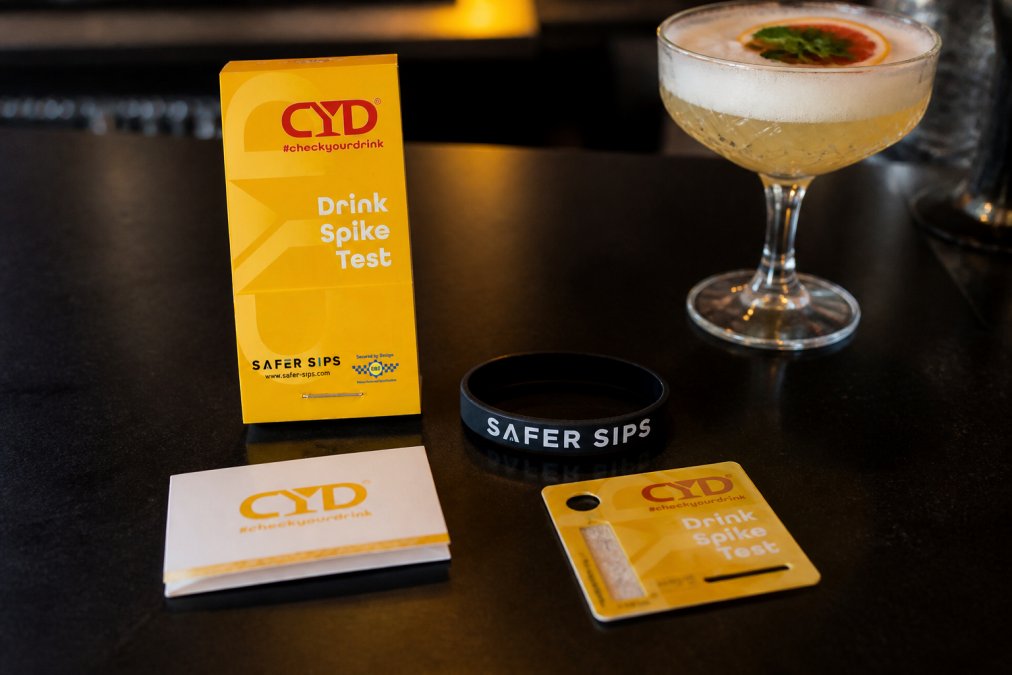
Drink spiking test strips vary significantly in quality, detection range, and independent verification. When evaluating any product, the most important questions are: which substances does it detect, how was it tested, and by whom?
Which Substances Do They Detect?
The most commonly spiked substances are GHB and Ketamine. A reliable test strip should detect both. Beyond those two, broader detection coverage is genuinely useful: many amine-based sedatives, tranquillisers, and central nervous system depressants share structural similarities that a well-formulated reagent can identify.
Safer Sips strips detect GHB, Ketamine, and over 650 amine-based compounds, a detection range built through years of independent research. Products that only list one or two target substances offer narrower protection.
Compatibility With Different Drink Types
Test strips perform reliably in most standard drinks: beer, wine, spirits, and mixed cocktails. The chemical reaction is triggered by the presence of the target compound, not by the drink's composition. Very dark-coloured drinks (such as red wine or dark spirits) can occasionally make a colour-change result harder to read visually. Carbonated beverages may require a moment to settle before testing.
Test strips also work in non-alcoholic beverages and mocktails, an important point since spiking is not limited to alcoholic drinks.
Step-by-Step: How to Test Your Drink Discreetly at a Party
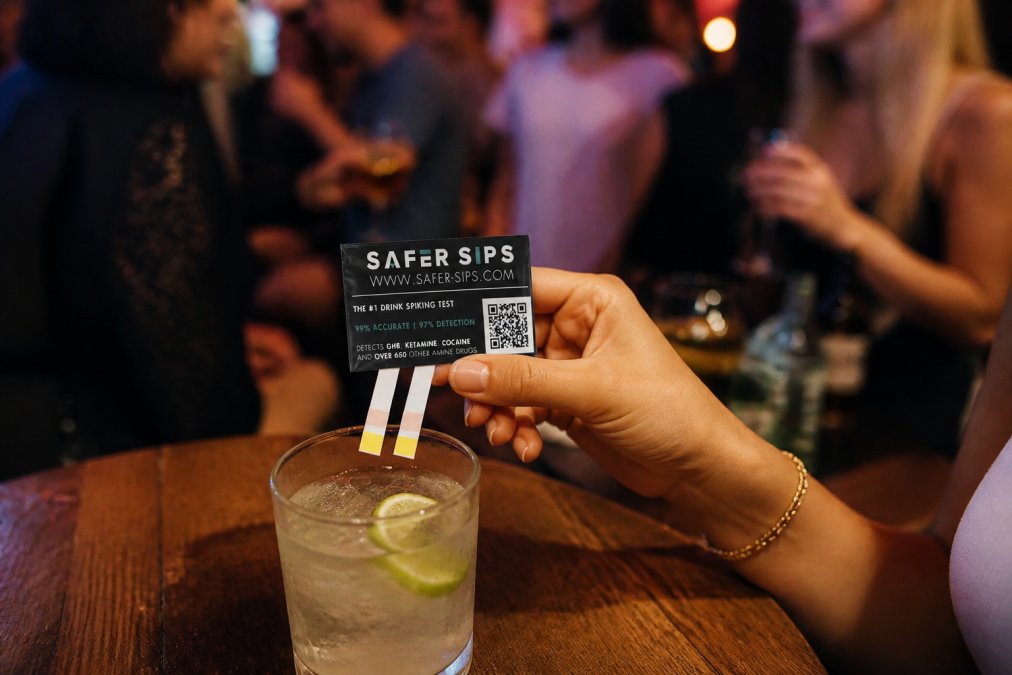
Testing your drink at a party doesn't need to be obvious. With the right format and a bit of preparation, the whole process takes under 30 seconds and looks no different from checking your phone.
-
Choose your format before you go out. A wristband or card-style strip keeps the test immediately accessible.
-
Test as soon as you receive your drink. The earlier you test, the more useful the result.
-
Find a low-light moment. Step to the edge of the bar, a quiet corner, or the bathroom.
-
Apply a small sample to the test strip. Dip the strip tip into the drink for the time specified on the packaging (usually 2-5 seconds).
-
Wait for the result. Most strips produce a readable result within 10-30 seconds.
-
Interpret the result correctly. A colour change indicating a positive result means stop drinking immediately. No change means the drink has tested negative for the target substances.
-
Dispose of the strip discreetly. Single-use strips can be folded and pocketed or dropped in a bin.
How to Prevent Drink Spiking Before It Happens
Testing is one layer of protection. Situational awareness is another. The most effective harm reduction approach combines both.
Situational Awareness and Social Safety Habits
Preventative measures start before you take your first sip. Never leave your drink unattended. Accept drinks only from bartenders or people you trust. Use a drink cover to deter opportunistic spiking. Go out with people who look out for each other. Trust your instincts, if something feels wrong about a situation, leave it.
According to Crime Prevention guidance from the Australian Institute of Criminology, environments with higher patron density and lower staff-to-customer ratios are associated with greater risk of opportunistic offending, which maps directly to drink spiking risk at large-scale events.
Overcoming the Social Barriers to Testing
The biggest obstacle to testing your drink at a party isn't access to a test strip. It's the social pressure not to. Many people worry that pulling out a test strip will look paranoid or signal distrust in a social group. These concerns are real but worth examining directly.
Testing your drink is a normal, rational response to a genuine risk. Framing it as a routine habit rather than a reaction to suspicion helps. "I always test my drink at events" is a much easier social statement than "I think you might have spiked this." As harm reduction becomes more mainstream, testing is increasingly visible at festivals and large events. Harm reduction principles from the Australian Drug Foundation support normalising protective behaviour as central to effective public health strategy.
What to Do If You Suspect Your Drink Has Been Spiked
Suspecting your drink has been spiked is a medical emergency. Act immediately, don't wait to see whether symptoms worsen.
Immediate Steps and Emergency Response
- Stop drinking the beverage immediately. Set it aside and do not let anyone else drink it.
- Tell someone you trust. A friend, venue staff member, or security guard.
- Call 000 or ask venue staff to call. If you feel unwell, dizzy, or confused, request emergency medical assistance.
- Preserve the drink if possible. Keep the glass or bottle; it may be needed as evidence.
- Do not leave the venue alone. Stay with someone you trust until you feel safe and assessed.
- Avoid taking anything to counteract the symptoms. Other substances, including alcohol, can interact dangerously with sedatives.
Legal and Medical Aftermath: Reporting and Evidence Preservation
Reporting drink spiking matters, both for your own medical care and for preventing it from happening to others. At the hospital, tell medical staff exactly what you suspect happened and when. A urine or blood sample taken promptly gives toxicology the best chance of detecting the substance. Many sedatives metabolise quickly; GHB in particular can clear the system within hours.
To report the incident, contact your local police. Drink spiking is a criminal offence in every Australian state and territory. Reporting sexual assault and drink spiking through the Australian Federal Police provides guidance on how to make a formal report and what to expect from the process.
Keep a written record of everything you remember: the venue, the time, who you were with, what you drank, and when symptoms began.
Drink spiking remains an under-reported harm that affects people across all kinds of social settings. The right tools make a real difference. Safer Sips offers independently tested detection strips with a 99% accuracy rate, available in formats designed for every situation: single and double strip cards for everyday use, an 8-strip matchbook pack for groups and festivals, and wristband testers for hands-free access at events. If you're serious about beverage security, get started with Safer Sips and take reliable, discreet protection wherever the night takes you.

Frequently Asked Questions
How do drink spiking test strips work?
Drink spiking test strips use a reagent-based chemical reaction to detect the presence of specific substances in a beverage. You apply a small drop of your drink to the test area on the strip or card. Within seconds, a colour change indicates whether a target substance, such as GHB or ketamine, is present. The reaction targets amine-based compounds and central nervous system depressants. No lab equipment is needed, and the entire process takes under 30 seconds.
Are drink spiking test kits accurate for GHB and ketamine?
High-quality test strips developed with independent laboratory testing can reach accuracy rates of around 99%, with detection rates close to 97% for substances like GHB and ketamine. However, no test is infallible. False negatives can occur if a substance is present below the detection threshold, and some drink types, particularly those with strong colours or high acidity, can occasionally affect the chemical reaction. Always treat a negative result as one layer of protection, not a guarantee.
What should I do if I suspect my drink has been spiked?
Stop drinking immediately and tell a trusted friend or venue staff. Move to a safe, well-lit area and do not leave alone. If you feel unwell, call 000 for emergency services. Preserve the drink if possible, it can be used as evidence. Seek medical attention even if symptoms seem mild, as sedatives and central nervous system depressants can escalate quickly. Report the incident to police as soon as you are safe; early reporting improves the chance of a successful investigation.
Can I use drink testing strips on non-alcoholic beverages and mocktails?
Yes. Drink spiking test strips work on non-alcoholic beverages, mocktails, water, and soft drinks, as well as alcoholic drinks. Beverages with very dark colours, such as cola or dark juices, can sometimes make colour-change results harder to read clearly. For best results with darker drinks, apply the sample to a white surface or use a test card format that separates the sample from the beverage visually. Always follow the specific instructions included with your test product.
This article was written using GrandRanker